Diving Lanai Cathedrals: Two Dives with Dive Maui from Lahaina
Quick Overview
Activity: Scuba Dive
Dive operator: Dive Maui
Location: Lahaina, Maui → Lānaʻi
Sites: Wash Rock & First Cathedral
Depth: Approximately 65–68 feet
Highlights: Swimming through a school of bluestriped snappers at Wash Rock & spending time inside First Cathedral
Diving Lanai Cathedrals has been on my bucket list ever since I learned about it. The dive sites around Lānaʻi are often described not just as one of Hawaii’s best dives, but as one of the best dive sites in the world. This summer I finally had a chance to cross it off the list. Here’s my experience diving Lanai Cathedrals.
What is Lanai Cathedrals?
Lanai Cathedrals is a collection of dive sites off the coast of Lānaʻi, the island just west of Maui that you can see from West Maui on a clear day. The area is known for its dramatic underwater lava formations, including caves, arches, swim-throughs, and caverns. There are several dive sites in the area, but First Cathedral and Second Cathedral are the two most famous.

First Cathedral is particularly well known for its enormous cavern, where openings in the lava rock allow sunlight to stream down into the water, creating the cathedral-like effect that gave the site its name. The Cathedrals are considered some of the best diving in Hawaii and have earned a reputation as a world-class dive destination.

Diving LANAI Cathedrals with Dive Maui

There are only several operators on Maui that offer dives at Lanai Cathedrals. We booked a two-tank trip with Dive Maui out of Lahaina, with First Cathedral as the dive I was most excited about.
We arrived at Dive Maui’s Lahaina storefront at 6:30AM and found parking on the street nearby. Our rental gear had already been set up on chairs outside the shop, so we were able to try everything on and make sure the fit was right before heading to the boat at 6:50 (the dock is just a short walk from the Dive Maui shop).
There were ten divers on our boat, and Dive Maui divided us into two groups. Six divers were assigned to one guide while Jim and I + two other divers were with our guide, Brian.

I really appreciated how organized the boarding process was. We were divided into two groups, each with its own guide, with the groups positioned on opposite sides of the boat. That made it easy for Brian to talk to our group during the roughly 45–50-minute ride from Lahaina to Lānaʻi and explain what we might see and what to expect on the dives. When we arrived, we could gear up right where we were and simply backroll into the water without everyone having to move around or crowd together.

Dive One: Wash Rock
Our first dive site was Wash Rock, known for its lava formations and swim-throughs.

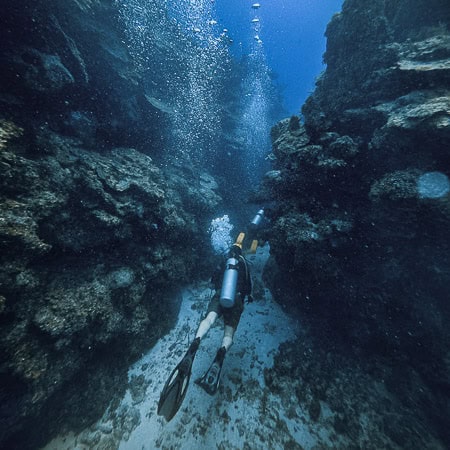
Immediately after descending, we encountered a lava tube that we could swim through. It wasn’t like the enormous cavern at First Cathedral, but it had the same exciting feeling of entering a space created by volcanic activity and then emerging somewhere else. Inside the lava tube our guide shined his flashlight into nooks and crevices where lots of squirrelfish were swimming.

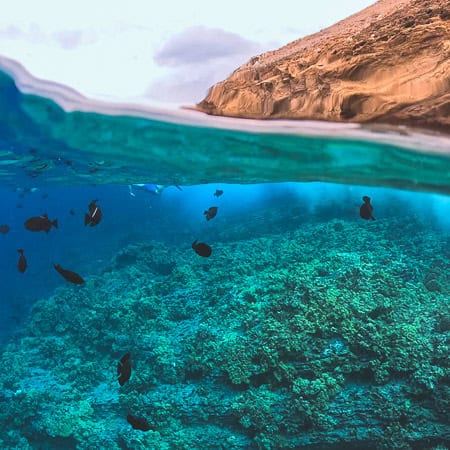
We spent the rest of the dive exploring the reef and lava formations around the site, reaching a maximum depth of about 65 feet.

We saw an octopus hiding in the rocks, moray eels, a bicolor nudibranch, yellow tangs, and lots of whitetail chromis hovering above the reef. There were also lots of other reef fish.


My favorite part of the dive at Wash Rock was a huge school of bluestriped snappers. I’m used to fish darting away when I try to get close, but these ones let me swim right through the middle of their school.

The Surface Interval
Once we were back on the boat, we removed our gear and settled in for our surface interval. The crew changed our tanks while we relaxed and munched on snacks. Rather than sitting in one place for the entire surface interval, the boat slowly made its way toward our second dive site.
As we approached the site, we could see rocks sticking above the surface of the water–this is the top of the First Cathedral.

Dive Two: First Cathedral
First Cathedral is the dive that had been living in my head for the last couple of years, and it was just as amazing as I had imagined. The light coming through the openings creates dramatic beams and illuminates sections of the cavern while other areas remain dark. It’s easy to understand why people call it a cathedral.

“The altar” sits inside the cavern. It’s a large rock that fell from the ceiling, and the way it lights up in the rays of sunlight is pretty spectacular.

It’s a completely different feeling from being out on an open reef.
We made our way toward the exit, sometimes called the “shotgun.” It’s a much smaller opening on the left side of the cavern. The current made getting out a little more challenging than getting in. It wasn’t anything we couldn’t handle, but it definitely added some excitement to the exit and took me more than one try.


I actually wish we’d been able to spend a little more time inside the Cathedral. I had built it up so much in my head that I wanted to just hover inside and take it all in. But dive time is dive time, and we had to move on.
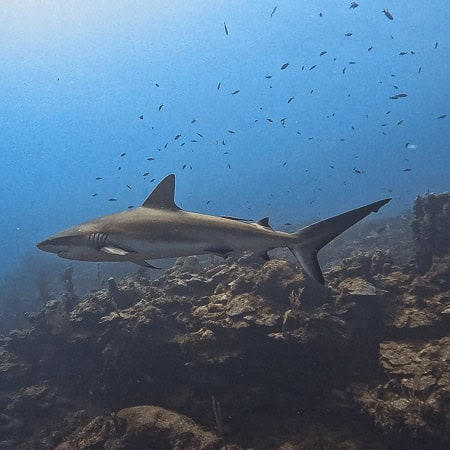
A White-Tip Reef Shark After First Cathedral
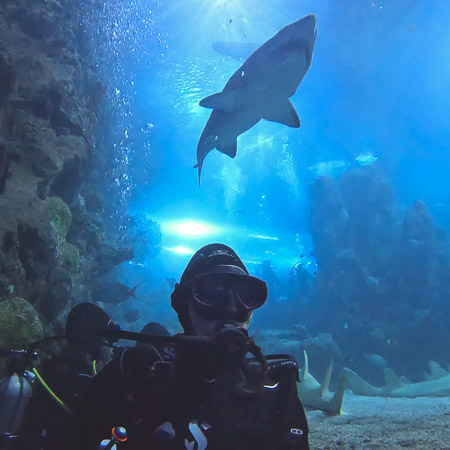
Shortly after leaving the Cathedral, we found a white-tip reef shark resting underneath a ledge. Seeing a shark is always exciting!

From there we explored a large coral garden where there was a large variety of reef fish. On this dive we reached a depth of about 68 feet.

Marine highlights on dive two were: a huge lobster tucked into a crevice in a rock wall, another octopus hiding in an opening on the ocean floor, and a sea turtle.

What We Saw Diving LANAI
We didn’t photograph every creature we encountered, but over our two dives we saw a pretty great variety of marine life.

Among the highlights were:
- White-tip reef shark
- Sea turtle
- Octopus
- Viper moray eel
- massive Hawaiian spiny lobster
- Bicolor nudibranch
- Yellow tang
- Sailfin tang
- Large schools of Whitetail Chromis and Bluestriped Snapper
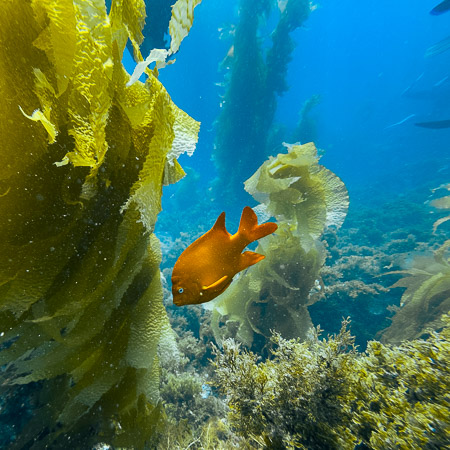
- Hawaiian dascyllus aka Domino damselfish
- Kole Tang
- Plenty of other tropical reef fish


And, of course, the lava formations and swim-throughs were just as much a part of the experience as the animals.

Was First Cathedral Worth the Hype?
I’d heard Lānaʻi Cathedrals described as one of the top ten dives in the world, and when you hear something described as a bucket-list dive enough times, it’s almost impossible for the actual experience to compete with the version you’ve imagined in your head.
The Cathedral itself absolutely lived up to the hype. Swimming inside the cavern, with sunlight streaming through the openings above, was dramatic and memorable. My only disappointment was that I didn’t get to spend quite as much time inside the Cathedral as I’d imagined. Time really does fly underwater, and just as I was settling in and taking it all in, it felt like it was time to move on. I found myself wishing we could have lingered there a little longer.

Would I Dive LANAI Again?
Absolutely! I loved the experience and would happily go again. If diving were free, I’d probably be out there every day. 🙂 But boat diving in Hawaii is a significant splurge, so realistically, I don’t think I’d do it more than once or twice more. That said, taking photos inside the First Cathedral was one of the highlights of the trip, and I’d love the chance to do it again—especially with a little more time to explore and photograph it. And, of course, I’d love to see the Second Cathedral, too.

Planning a LANAI Cathedrals Dive from Maui

If you’re considering diving Lanai Cathedrals while visiting Maui, expect to spend some time on the boat. The trip from Lahaina to Lānaʻi takes roughly 45–50 minutes each way, so this isn’t a quick excursion.
Our two-tank trip included:
- Boat ride from Lahaina to Lanai
- Two dives
- Dive gear rentals, available for an additional per-item fee
- A guide for each small group
- Tank changes between dives
- Snacks during the surface interval

If you’re staying on Maui and interested in a simpler shore dive with some of the same lava tubes, swim-throughs, and shafts of light (but on a smaller, less dramatic scale) consider a shore dive at Makena Landing in south Maui.
Tip: Plan your time around Haleakala
If you’re planning to visit Haleakala, do it before diving or leave plenty of time afterward. As a general rule, divers should avoid ascending above 8,000 feet for at least 12 hours after a single dive and 18–24 hours after multiple dives or multiple days of diving. Since Haleakala’s summit is over 10,000 feet, you’ll want to plan your Haleakala visit accordingly.
The exact dive sites and conditions can vary, so our experience at Wash Rock and First Cathedral shouldn’t necessarily be taken as the exact itinerary for every Lānaʻi trip.

For us, though, it was a really enjoyable day of diving—and one I’m glad we added to our Maui trip. And next time, I’m hoping to see the other Cathedral!